All case studies

Case study · A national professional services firm

From 200 AI ideas to a portfolio worth funding.

The audit practice of a national professional services firm did not have an idea problem. It had roughly 200 of them, and no disciplined way to decide which ones deserved the firm's money.

Audit innovation · Professional services. The client is described, not named, by agreement.

200
AI and automation initiatives surfaced across the audit business
15
Opportunities carried into deep validation
$7.1M
Projected year-one value in the standout opportunity
1
Initiative now live in production

The problem: too many ideas, no common yardstick

Teams across the audit business could see exactly where AI, automation, and process improvement would help: work that was slow, manual tasks repeated at scale, knowledge that was difficult to reach, and processes where inconsistency created error risk. The ideas were good. There were simply too many of them to fund, and no fair way to compare them.

Each idea arrived with a different sponsor, a different story, and a different measure of value, so leadership's questions had no consistent answers. Which of these are genuinely valuable? Which merely sound innovative? Which deserve funding now, which need more validation first, and which should be stopped before they consume real money? The challenge was never generating innovation. It was turning innovation into investment decisions.

What we did: focus first, then a framework

Working alongside the firm's audit innovation leaders, Iteright began with focus. An initial prioritization pass reduced the universe of roughly 200 initiatives to a portfolio of 15 leading candidates that merited deep analysis. The long tail was not ignored. It was sequenced, so the firm's best analytical effort went where the potential value was highest.

Then we built the piece the firm had been missing: one validation framework applied to every candidate in exactly the same way. No idea would advance because its sponsor presented well, and none would die because its sponsor presented badly.

$7.1M
in projected year-one value, in a single opportunity the portfolio process surfaced and validated.

How we did it: the same hard questions, every time

Every opportunity in the deep-validation group had to answer the same questions, with evidence:

  • What problem are we actually solving, and who experiences it?
  • How often does it occur, and what does it cost in time and money?
  • What materially improves if we solve it, and how large is the economic impact?
  • What would the solution cost to build and run, and how difficult is it to deliver?
  • What risks and dependencies stand behind the assumptions?
  • Is this the best use of the same people and capital, compared with the alternatives?

The framework produced two kinds of answers, and both were valuable. It identified investments with significant upside. It also identified initiatives that did not justify continued resources, and gave leadership the confidence to stop them. A portfolio process that can only say yes is not a process. It is a rubber stamp.

The outcome: one standout, now in production

One opportunity separated itself from the field: a knowledge-management assistant for the audit organization. Auditors depend on large bodies of institutional and technical knowledge, and finding the right answer was consuming expensive professional time while inconsistency created error risk. The validated economics were difficult to argue with: approximately $7.1M in projected value, driven by productivity gains and a reduction in auditor errors, against a build cost of roughly $40,000.

The initiative did not end as a recommendation in a deck. It moved through development and into production. That is what makes this a strategy-to-impact story. The firm already had the ideas and the expertise. What it gained was a system for judgment: capture the knowledge, structure the opportunities, compare them honestly, and invest deeply only where value, evidence, and feasibility meet.
The mechanism, in detail

How it worked: strategy to idea to plan

The firm did not need more ideas, and it did not need a bigger funnel. It needed the ideas it already had to pass through one fair process on the way from a strategic theme to a funded plan. The funnel below is that process, run the same way for a small automation and for a major platform bet.

  1. Intake into one portfolio view

    Roughly 200 AI and automation initiatives were captured in one place, each described in the same shape: the problem, who experiences it, how often it occurs, and what it costs in time and money. An idea could no longer hide behind a strong sponsor or a polished deck, because every idea arrived in the same format.

  2. A first pass for focus

    An initial prioritization pass reduced the 200 to the 15 candidates that merited deep analysis. The rest were sequenced rather than discarded: parked with a reason recorded, so the firm's best analytical effort went where the potential value was highest.

  3. Deep validation on shared evidence

    Each of the 15 answered the same questions, with evidence: what the problem costs, how large the improvement could be, the economic impact, what the solution costs to build and run, how difficult it is to deliver, what risks and dependencies stand behind the assumptions, and whether the same people and capital would do more good elsewhere.

  4. Fund the few, stop the rest on the record

    Validation produced both kinds of answer. A small set of opportunities earned the case for funding. Others were stopped, with the reasoning kept, which is what gave leadership confidence that the process was a filter and not a rubber stamp.

  5. Take the winner to production

    One opportunity separated itself: a knowledge assistant for the audit organization, where finding the right institutional answer was consuming expensive professional time and inconsistency created error risk. The validated economics projected roughly $7.1M of year-one value against a build cost of roughly $40,000. It moved through development and into production.

The validation funnel

~200 initiatives

Surfaced across the audit business, captured in one view

One framework

The same questions and the same evidence for every idea

15 validated in depth

The candidates worth the firm's best analysis

1 live in production

The auditor knowledge assistant

The funnel narrowed on evidence at each stage, not on enthusiasm. Ideas that did not advance were sequenced or stopped, with the reasoning kept either way.

The funnel, by the numbers

StageInitiativesWhat happened at this stage
Surfaced~200Every AI and automation idea in the audit business, in one portfolio view
Carried into deep validation15Full evidence pass: problem cost, expected impact, build and run cost, risk, opportunity cost
Stopped or sequencedThe remainderParked or closed with the reasoning recorded, not left competing for air
Live in production1Auditor knowledge assistant, with $7.1M in projected year-one value

Counts are the engagement's published figures. The $7.1M is the validated projection for the standout opportunity.

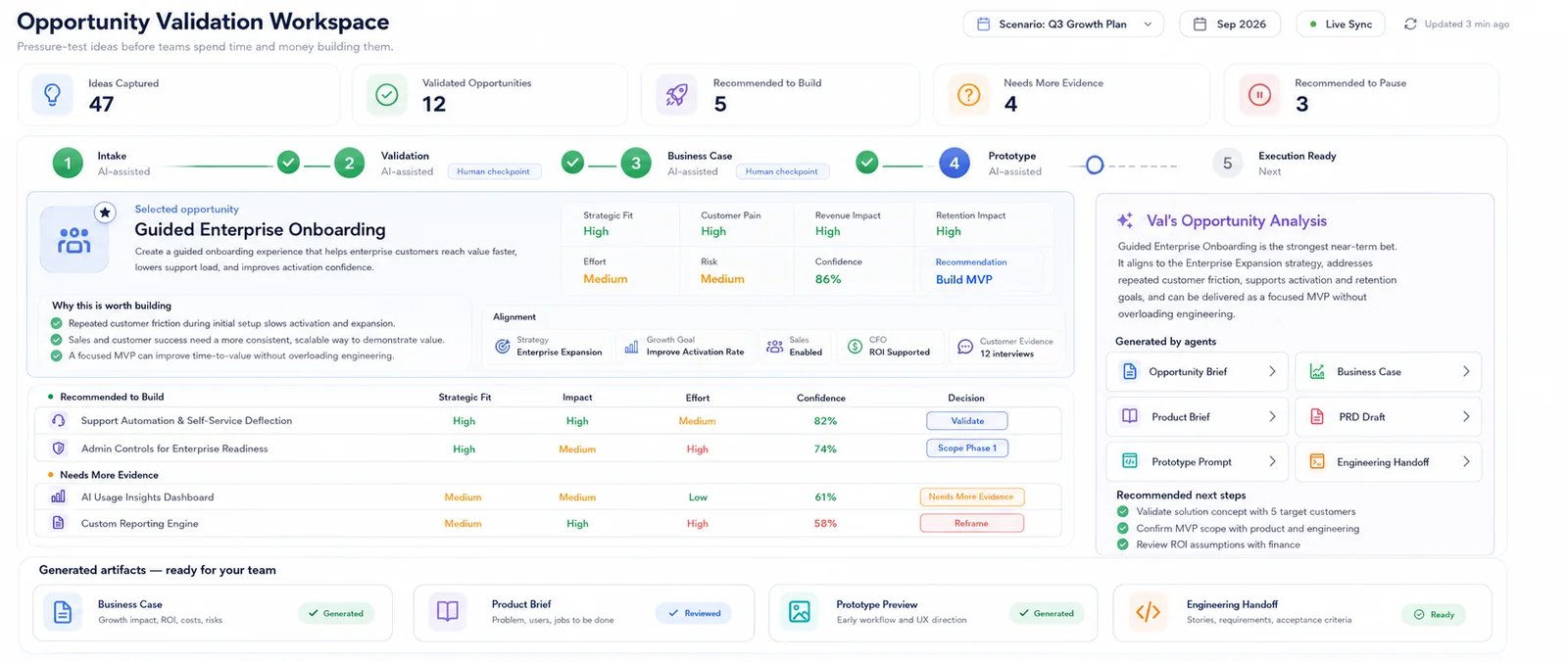
Iteright product view of an opportunity validation workspace, with captured ideas moving through validation stages and recommendations to build, gather more evidence, or pause
The validation workspace: every candidate scored on the same evidence, with build, more evidence, and pause recommendations kept separate. Product view, shown with demonstration data.
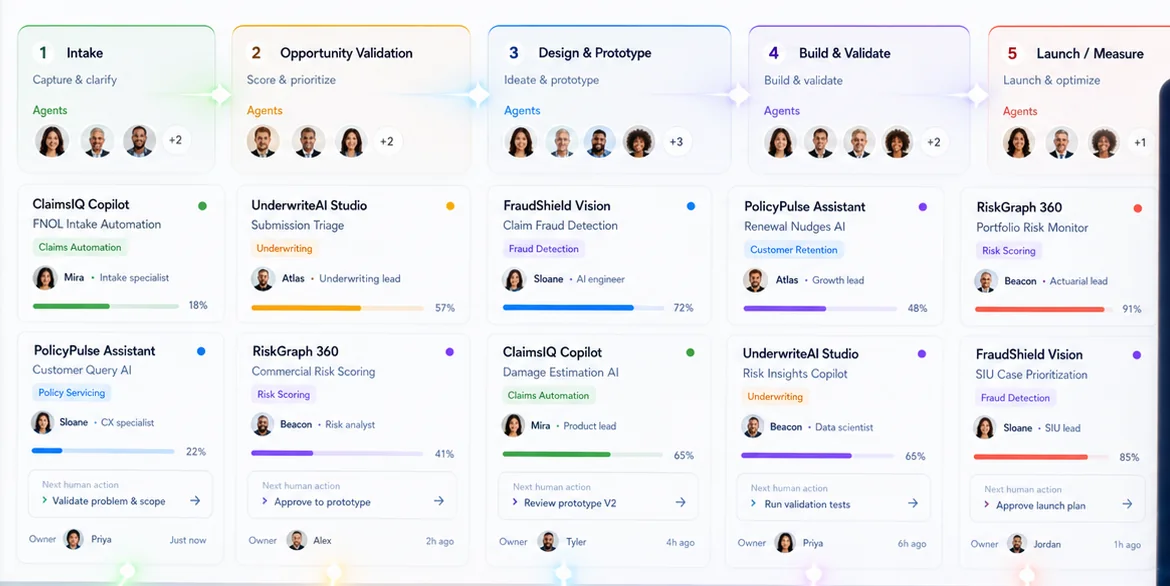
Iteright product view of an ideas pipeline board, with candidate initiatives moving through intake, opportunity validation, design, build, and launch stages
One pipeline for every idea: intake through validation to a build decision, so no initiative advances on presentation alone. Product view, shown with demonstration data.

The framework the 200 were run through

The firm did not judge its 200 initiatives on instinct. It brought specific criteria of its own, and every candidate was scored on the same framework, in the same way, inside Iteright. Five lenses carry weight. The heaviest, Idea Analysis at 55%, is itself seven questions every idea had to answer. A sixth element, the initiative plan, is required of anything funded but carries no weight: it describes how the opportunity would actually be brought to market.

LensWeightWhat it examines
Strategy Alignment15%Whether the idea is in harmony with the organization's strategic goals, with a direct path to measurable impact, detailing how the initiative contributes to broader business objectives.
Persona10%The target customer's needs and challenges, delved into properly: the component that tailors solutions to real-world problems and ensures relevance and value.
Idea Analysis55%The idea itself, examined through the seven questions in the next table: need, solution, alternatives, positioning, growth, viability, and risk.
Evidence10%The data and research supporting the idea's validity and potential success: the evidence base that gives each initiative depth and credibility.
Financial5%The financial outlook, including cost analysis and revenue projections, essential for evaluating the idea's economic viability.
InitiativesNot weightedThe actionable steps and tools required to bring the opportunity to fruition: the workflow, milestones, and timelines critical to successful delivery.

Weights as defined in the firm's framework. A low total was not an insult and a high total was not a guarantee; the score's job was to make 200 unlike ideas comparable on one page.

Inside the 55%: the seven Idea Analysis questions

More than half the score sat in one lens, and that lens was a structured interrogation of the idea itself. Every candidate, from a small automation to a platform bet, had to answer all seven questions with evidence.

QuestionWhat it asks
Problem & Market NeedWhat pressing customer or business problem does this idea tackle, and what evidence proves a sizable, urgent market need?
Proposed SolutionHow does the proposed solution resolve the problem and deliver unique, quantifiable value?
Alternatives & CompetitionHow is the problem currently addressed, and how will this approach outperform or differentiate from existing alternatives?
Positioning & LaunchHow will the offering be positioned, which target segment will it serve first, and what is the launch strategy?
Growth & ScalabilityWhat strategies will acquire, retain, and scale users or customers sustainably?
Technical ViabilityWhat technology, data, and resources are required, and is building or integrating them technically feasible within constraints?
Risks & MitigationWhat are the most significant risks or uncertainties, and what mitigation or contingency plans will be implemented?

The winner's economics

The standout was not the most ambitious idea in the funnel. It was one of the cheapest things in it. The auditor knowledge assistant cost roughly $40,000 to build and took a few months of effort, delivered with a vendor alongside internal teamwork.

The problem it solved was repetition at scale. The same questions arrived to the same group of people over and over, and answering them was mundane work that dragged specialists away from the work only they can do. The assistant was built on the firm's own context plus its knowledge base, so the most common, frequently asked questions get a fast answer drawn from the firm's actual material, and the expensive humans get their hours back.

Where the $7.1M comes from

The $7.1M year-one figure is not a revenue forecast. It is mostly time, priced. Hundreds of service staff were each spending roughly 10% of their time answering those same recurring questions. Count that share across hundreds of professionals and price the hours, and the recovered time accounts for the majority of the $7.1M, as cost savings. On top of that sits roughly $2M more: the value of pointing the freed time at revenue-growing opportunities instead. That second figure is an assumption about what better-used hours earn, and it is counted separately, as assumed opportunity value, not blended into the savings.

ComponentBasisHow it is counted
Recovered timeHundreds of service staff, each spending roughly 10% of their time on the same recurring questionsThe majority of the $7.1M, as cost savings
Redirected timeThe recovered hours pointed at revenue-growing work instead of repeated answersAbout $2M more, as assumed opportunity value

The distinction is the point. The savings are arithmetic: hours, counted and priced. The opportunity value is a judgment about what those hours are worth in a better place, presented as an assumption wherever the number travels. A portfolio number that separates what was measured from what was assumed is a number leadership can defend in the room where the next budget gets decided.

The lasting change was not the one system that shipped. It was the yardstick. A new AI idea at the firm no longer competes on how well it is presented. It enters the same funnel, answers the same questions, and earns its place against the same alternatives.

Free. No Credit Card. No Prep. No Commitment.

Your Free Strategy Execution Snapshot.

Bring what you have. Leave with a clearer picture and a concrete plan.

Free.

No credit card · No prep · No commitment

Bring what you already have

Bring your roadmap, tickets, strategy notes, Jira or ADO export, Linear board, spreadsheet, or even a rough list of priorities. No cleanup, integrations, or long onboarding required — we do the work to turn what you already have into a clear picture of where effort is going, what is aligned, where things have drifted, and exactly what to do next.

  • Roadmap or strategy doc
  • Jira, ADO, or Linear export
  • Backlog or ticket list
  • ServiceNow demands
  • Spreadsheet or rough list of ideas

What you walk away with

  • Strategy-to-Execution Map

    See how goals, roadmap, initiatives, and active work connect.

  • Work Focus & Drift View

    Understand where effort is going and what may be drifting from the plan.

  • Opportunity Decision View

    Know what to build, pause, clarify, validate, or measure next.

  • Outcome & Next Moves Summary

    Get the outcomes, measurement gaps, and 3–5 recommended next moves.

Get your free Strategy Snapshot

Bring anything. We do the work. You'll leave with more clarity either way.

Used by VP Products, GMs, strategy leaders, and founders at companies from growth-stage startups to billion-dollar organizations.